Introduction: Why Shape Matters in Vastu Shastra
In Vastu Shastra, shape is not merely geometry. It is a symbolic language through which nature expresses qualities, tendencies, and life outcomes. Ancient Vastu texts follow a deep tradition of symbolic expression, where form reflects function and destiny.
Whether it is:
- the shape of a city,
- the shape of land or plot,
- the shape of a building,
- the shape of a room,
—the core qualities remain the same. Only the intensity of effect changes depending on scale. This principle is clearly described in classical texts such as:
- Vishwakarma Prakash – Chapter 1
- Samarangana Sutradhara – Matrika Sthana Adhyaya
The Classical Principle of Shape and Quality
Vastu Shastra does not treat shapes as “good” or “bad” in isolation. Each shape carries a specific guna (quality) that influences the people living or working within that space.
Key Rule:
If all other parameters are kept constant (direction, slope, levels, entrance, usage),
the shape alone is capable of influencing Dharma, Artha, Kama, and Moksha.
This is why ancient architects never chose shapes randomly. Every form was selected with awareness of its psychological, social, and karmic impact.
---Square (Varga) Shape Land: The Most Balanced Form
Classical Meaning
Square-shaped land is considered the most complete and balanced form in Vastu Shastra. It represents stability, order, and symmetry.
Results When Other Factors Are Proper
- Supports Dharma (righteous conduct)
- Supports Artha (wealth and stability)
- Supports Kama (comfort and harmony)
- Supports Moksha (inner peace and spiritual growth)
This is why square shapes were traditionally preferred for:
- Temples
- Ashrams
- Royal buildings
- Ideal residential plots
Rectangular (Ayata) Shape Land: Practical and Prosperous
Accepted Proportion
Rectangular plots are considered auspicious when the length-to-width ratio remains within 2:1.
Primary Effects
- Strong focus on Dharma and Artha
- Good for growth-oriented families
- Supports planning, discipline, and expansion
Rectangular land is commonly suitable for:
- Residential houses
- Educational institutions
- Administrative and professional spaces
When the ratio exceeds 2:1, imbalance starts increasing and corrective planning becomes essential.
Understanding Shape Effects Across Scales
One of the most important but least understood principles in Vastu is this:
The same shape rule applies at every level.
City → Land → Plot → Building → Room
The difference lies only in intensity, not in nature.
| Level | Shape Influence |
|---|---|
| City Layout | Collective psychology, economy, culture |
| Plot Shape | Family stability, prosperity, health |
| Building Shape | Daily routine, confidence, discipline |
| Room Shape | Mental comfort, focus, emotional balance |
Why Irregular Shapes Need Careful Evaluation
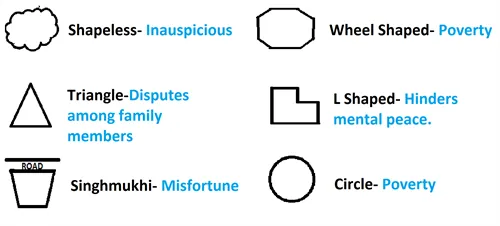
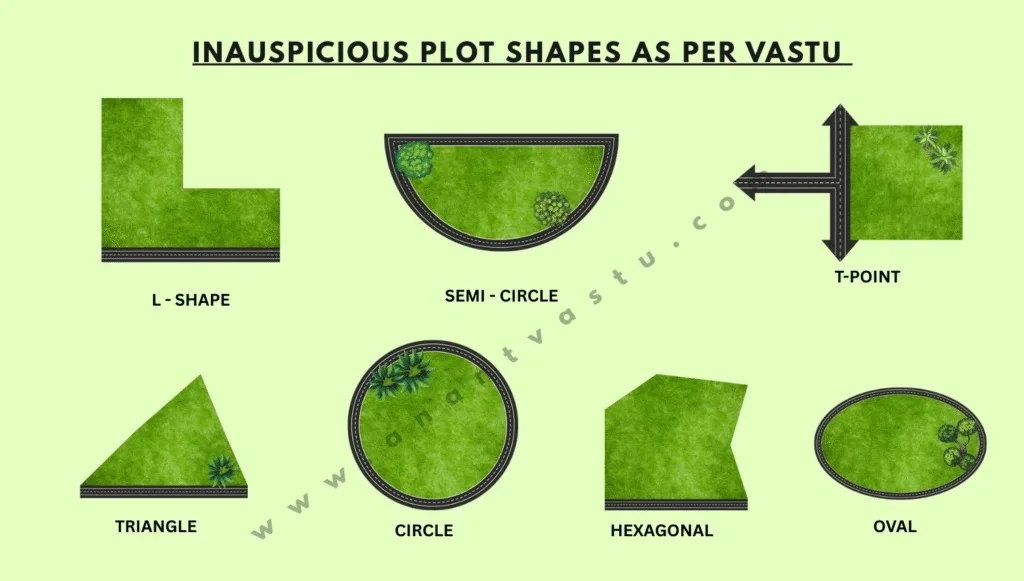
Every shape has a result. Irregular or complex shapes are not automatically harmful, but they tend to magnify certain traits:
- Restlessness
- Instability
- Overthinking
- Unpredictable outcomes
Such plots require:
- Careful zoning
- Proper weight distribution
- Correct functional placement
- Disciplined daily usage
Most Common Mistake People Make
Many people treat Vastu shapes as superstition or blindly label them as “good” or “bad”. Classical Vastu never works like that.
Shape shows tendency, not fate.
Correct planning can enhance good qualities and reduce negative intensity.
Conclusion: Shape Is Silent Influence
According to classical Vastu texts, shape quietly influences life without making noise. It does not force events—but it creates conditions in which certain outcomes become easier or harder.
To summarize:
- Square shapes support balance and completeness
- Rectangular shapes support growth and structure
- All shapes have results; awareness determines outcome
- Scale changes intensity, not quality
Final Truth:
Vastu works best when geometry, direction, usage, and discipline work together.
Shape is the foundation—not the shortcut.
If you wish to understand how your plot or building shape is influencing your life and what corrections (if any) are actually required, a detailed evaluation is always better than assumptions.